
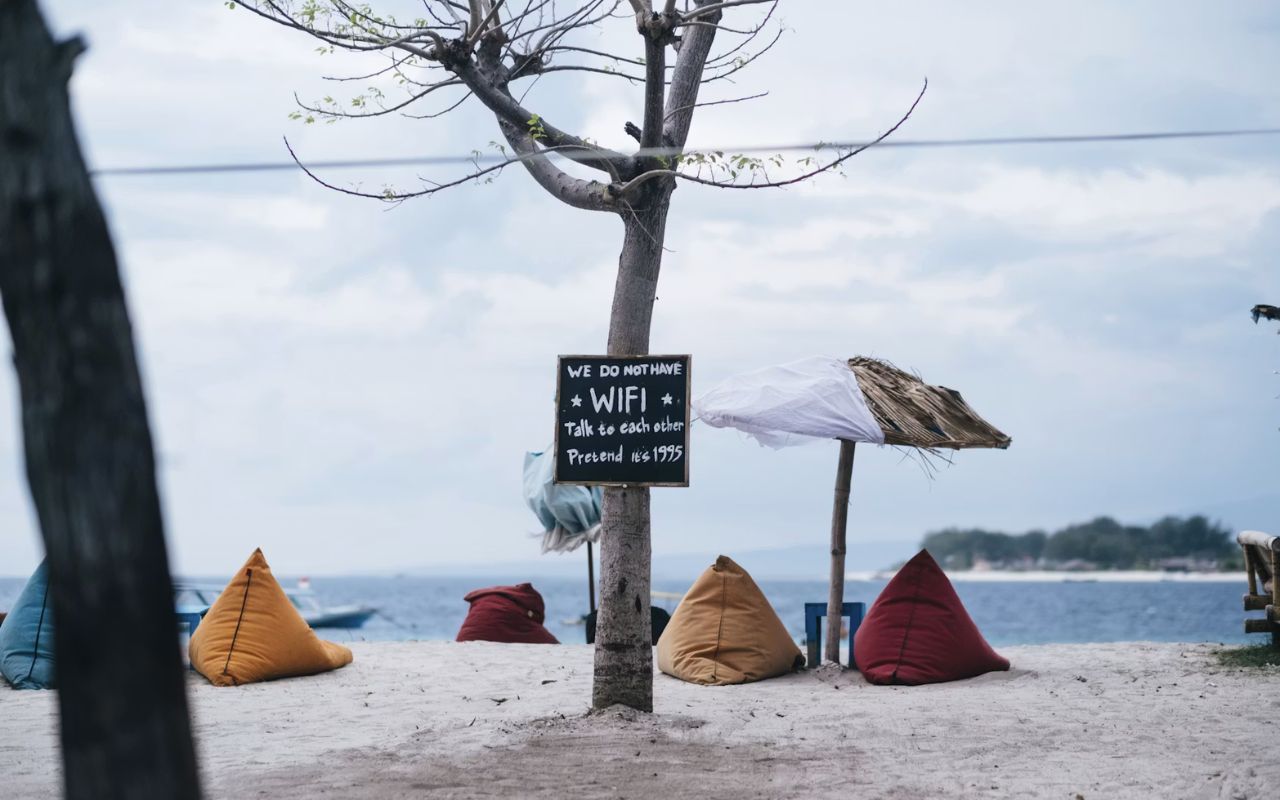
The layers between us and the world.
Most people don’t feel disconnected all at once. It happens gradually, almost imperceptibly, in the background of ordinary life. Nothing dramatic changes. You still see people, still speak to friends, still move through familiar places. And yet, over time, life can begin to feel slightly less direct than it once did.
Less immediate. Less grounded. Less lived.
One of the reasons for this is that so much of modern life is now mediated. We experience the world through screens, systems and schedules. We see photographs of places rather than arriving in them without expectation. We read updates about people rather than sitting with them for long stretches of unstructured time. Even our movement through the day is often broken into segments, each with its own purpose and endpoint.
Very little is continuous anymore.
In earlier forms of life, much of what we did was embedded in the environment we were part of. Work, food, movement and social life were not separate categories; they overlapped constantly. You saw the consequences of your actions immediately and repeatedly. You understood the weather not from an app but from the feeling of it. You knew people not through summaries of their lives but through shared time.
There was less distance between action and experience.
Modern life has created more comfort, more efficiency and more control, but it has also introduced layers between us and the world we move through. We often plan experiences in advance, travel to them, capture them, and then return from them. Even rest can become something scheduled and optimised rather than something that simply happens when conditions allow.
The result is not that life becomes worse, but that it becomes slightly less felt.
There is a difference between knowing something and experiencing it directly. You can know you are tired without ever fully resting. You can know you are socialising without feeling connected. You can know you are outdoors without really noticing where you are.
Much of modern wellbeing focuses on correcting this through more information, more structure and more optimisation. But the underlying issue may not be lack of knowledge. It may be the number of layers between us and what we are trying to experience.
When those layers are reduced, something subtle shifts.
A walk becomes less about tracking distance and more about noticing where your attention naturally goes. A meal becomes less about nutritional analysis and more about taste, pace and company. Time outside becomes less about its effect on stress and more about the simple fact of being in it.
The experience becomes primary again, rather than secondary.
At Wildfitness, this is something we pay close attention to. The intention is not to remove modern life or reject it, but to create moments where those layers fall away. Where movement is not something recorded but something felt. Where days are not segmented into outcomes but allowed to unfold. Where attention is no longer constantly divided between the present moment and its documentation.
People often notice this within a short time. Not because anything dramatic has changed, but because they are no longer experiencing everything at a slight remove. The landscape is not viewed through a window. Conversation is not interrupted by other inputs. Effort is not immediately translated into data.
Life becomes simpler, not in content, but in access.
And in that simplicity, many people describe a kind of clarity that is difficult to articulate afterwards. Not a transformation into someone new, but a return to something more immediate and familiar. A sense that things are happening directly again, without so many steps in between.
Perhaps that is what disconnection really is.
Not the absence of people, or nature, or meaning.
But the quiet accumulation of distance between us and our own experience.
And perhaps reconnection is not something we add, but something we remove the obstacles to.
What creates the feeling of disconnection?
Modern life can remove direct experience without us noticing. Work happens through screens, movement becomes scheduled, food arrives without preparation and conversation is often interrupted by alerts. None of these things is inherently wrong, but together they can leave fewer moments in which the body, attention, place and other people are fully involved in the same experience.
Disconnection can therefore feel less like loneliness and more like friction: difficulty settling, a sense of being mentally elsewhere, or the feeling that a busy day contained very little that was memorable.
How to reconnect without escaping ordinary life
- Choose one daily activity that is physical and screen-free.
- Spend time somewhere that changes with weather, light and season.
- Arrange regular face-to-face time around a shared activity rather than another appointment.
- Leave small parts of the day unfilled, so attention can return to what is immediately present.
The US Surgeon General’s advisory on social connection and community summarises evidence that meaningful connection is closely related to health and wellbeing. Wildfitness retreats create the conditions for connection, but the principle is useful anywhere: direct experience becomes easier when fewer layers sit between us and the world.
Continue with why we need community or explore the benefits of being in nature.