
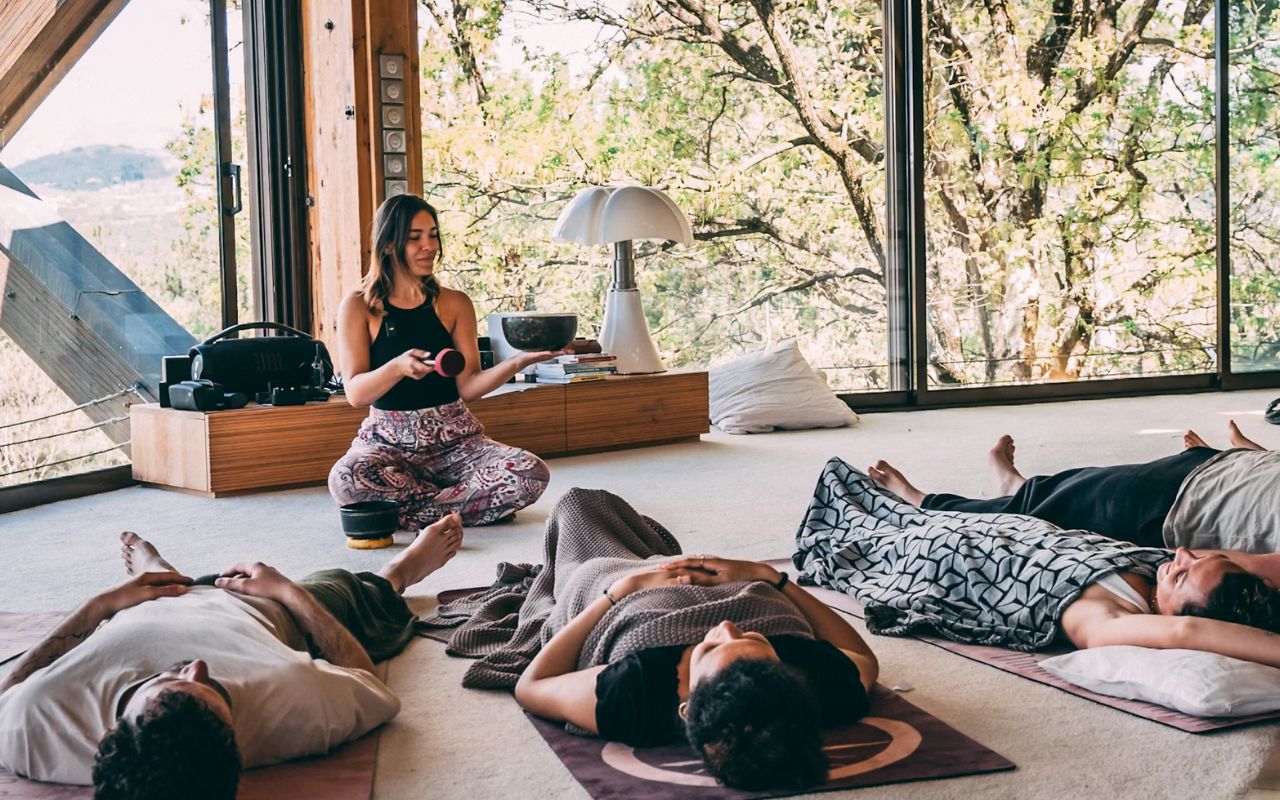
If you pause for a moment right now, you can probably feel it—the relentless, low-grade hum of modern life vibrating right beneath your skin. Our bodies have quite literally forgotten the physical language of true stillness. We confuse simply stopping with genuinely recovering. But sitting on a sofa while scrolling a screen rarely signals safety to a tired nervous system; it keeps it trapped in high-alert. True deep rest is not merely the absence of movement. It is the complete dissolution of effort. It is a sacred, quiet return to your baseline where your body finally stops compensating, stops defending, and finally begins to rebuild.
Deep rest is not simply more sleep
Sleep is essential, but deep rest also includes periods when the nervous system is not being asked to perform, decide or respond. It can be quiet time after movement, an unhurried meal, time in nature or a day with fewer inputs. The aim is not to force relaxation; it is to create conditions in which the body no longer needs to stay on alert.
Signs that ordinary downtime may not feel restorative
- You finish a break feeling as stimulated as when it began.
- Rest is filled with notifications, planning or passive scrolling.
- You are tired but find it difficult to settle.
- Even enjoyable activities feel like tasks to complete.
The NHS sleep and tiredness guidance offers practical support for persistent sleep or fatigue concerns. A retreat can support healthy routines, but it is not medical treatment; seek professional advice if tiredness is persistent, severe or unexplained.
See how these principles shape our rest and recovery retreats.
Rest is not a luxury that follows effort. It is the wild, foundational pillar that makes effort sustainable in the first place.
When we deny ourselves this depth, we survive on a permanent deficit. We mistake a state of constant internal alertness for actual living. In our work here, we have come to view deep rest as an essential biological homecoming. It is a soft, non-negotiable space where the mind finally quietens, the overstimulated senses settle, and the body remembers its innate capacity to heal itself from the inside out.
The quiet exhaustion we carry
Our modern environments are beautifully, almost aggressively designed to keep us perpetually switched on. Even our quietest moments of intended downtime are fractured by the incoming data of notifications and shifting attention. This constant background noise tricks our bodies into a state of survival readiness. We end up running on fumes, waking up exhausted even after a full night of sleep. Without intentional deep rest, your body never receives the clear, unambiguous signal that it is safe to downshift. This lack of genuine recovery is exactly why we experience persistent mental fog, emotional sensitivity, and a loss of our natural resilience. To break this cycle, we don't need to optimise our time or find a new wellness hack. We simply need to deepen our quality of presence by radically, unapologetically reducing our daily load.
Where the nervous system drops its guard
We have found that natural environments support recovery in a way that modern spaces simply cannot—by radically easing the weight of sensory life. Built environments constantly demand our attention and force rapid, defensive responses. Conversely, the wild offers us softer, unfragmented sights and sounds, and gradual, soothing shifts in light. These repetitive, ancient natural patterns act as a balm, quickly quietening a tired mind. It naturally encourages your stress response to drop its guard, combining a gentle sensory grounding that shifts your mind completely away from internal pressures, allowing your thoughts to slow down naturally, without force.
The nervous system begins to reset organically when life becomes simpler, quieter, and more aligned with the earth.
The necessary rhythm of contraction and release
In our philosophy, deep rest works best when it exists in a beautiful, fluid dance with natural movement and play. These are not separate ideas to be checked off an optimisation list; they support each other as part of an ancient, organic rhythm. Movement helps our bodies release accumulated physical tension, restore restricted circulation, and clear away mental static. Play helps us let go and move with joyous freedom and vitality. Rest then steps in to integrate, repair, and stabilise those vital changes. Together, they create a complete form of recovery that feels steady and organic rather than forced. What is so often missing in our modern lives is not just the time to rest, but the depth of it too. True rest requires a reduction in incoming stimulation, a shift in environment, and an absolute absence of expectation.
A glimpse into our evenings of quiet integration
We never add rest as an afterthought; we weave it into the very fabric of our experiences. Here, your life unfolds at a genuinely human pace through extended, unhurried time in natural surroundings. You will step into a slower rhythm of daily activity, feel the relief of reduced digital input, and enjoy completely unstructured periods with absolutely no agenda. Crucially, we gently close each day with a dedicated deep rest session. These evening practices are a warm invitation for your nervous system to fully downshift—whether through grounding breathwork, somatic release work, or a deeply resonant crystal sound bath immersion. We replace the pressure to perform or achieve with simple, nourishing meals and conditions optimised for restorative sleep, letting physical and mental recovery happen gradually and consistently.
An invitation to step out of the noise
If your body is ready to explore what deep rest truly is and why it matters to your living baseline, we invite you to join us. Our immersive luxury retreats across the UK and Europe are designed specifically to help you step out of the noise and restore your inner balance. Through protected time outdoors, movement, play and a radical reduction in daily stimulation, we will give your body and mind the vital, protected space it needs to settle, reset, and rebuild its natural rhythm.